|
|
||
|
||
![]() |
||
|
|
||
![]() |
||
|
Sidon Sidon, on the coast 48
kilometers south of Beirut, is one of the Famous names in ancient
history. But of all of Lebanon's cities this is the most mysterious,
for its past has been tragically scattered and plundered.
In the 19th century, treasure hunters and amateur archaeologists made off with many of its most beautiful and important objects, some of which can now be seen in foreign museums. In this century too, ancient objects from Sidon (Saidoon is the Phoenician name, Saida in Arabic), have turned up on the world's antiquities markets. Other traces of its history lie beneath the concrete of modern constructions, perhaps buried forever. The challenge for today's visitor to Sidon then is to recapture a sense of this city's ancient glory from the intriguing elements that still survive. The largest city in south Lebanon, Sidon is a busy commercial center with the pleasant, conservative atmosphere of a small town. Since Persian times this was known as the city of gardens and even today it is surrounded by citrus and banana plantations. Archaelogical
Excavations
Early French
excavations led by Ernest Renan in the late 19th century uncovered
the large necropolis of Magharat Abloun outside the city. The royal
necropoli at nearby Ayaa and Ain el-Helwe were found shortly
thereafter. The entrance to Sidon
from the north is on a wide divided highway lined with palm trees.
As you approach, the landmark Crusader Sea Castle and modern port
installations are immediately visible. The busy main street is full
of small shops of every kind, including patisseries, whose oriental
delicacies are stacked in little pyramids. The particular specialty of Sidon is known as "senioura," a
delicious crumbly cookie. Is a fortress built by the Crusaders in the early 13th century on a small island connected to the mainland by a causeway. A climb to the top leads to the roof where there is a good view of the port and the old part of the city. Today the castle
consists primarily of two towers connected by a wall. In the outer
walls Roman columns were used as horizontal reinforcements, a
feature often seen in fortifications built on or near former Roman
sites. The west tower is the better preserved of the two.
Old prints of the
fortress show it to be one of great beauty, but little remains of
the embellishments that once decorated its ramparts. After the fall
of Acre to the Mamlukes all the sea castles were destroyed to
prevent the Crusaders from re-establishing footholds on the coast.
The interior has
vaulted ceilings and medieval decor. There is also a fine patio with
a fountain. Between the Sea Castle
and the Castle of St. Louis stretches the old town. Not far from the
Sea Castle is the picturesque vaulted souk of Sidon, where workmen
still ply their trades. On the edge of the souk
is a traditional coffee house where male clientele meet to smoke the
narguileh (water pipe) and drink Turkish coffee. Fishermen sell
their latest catch at the market near the port not far from the
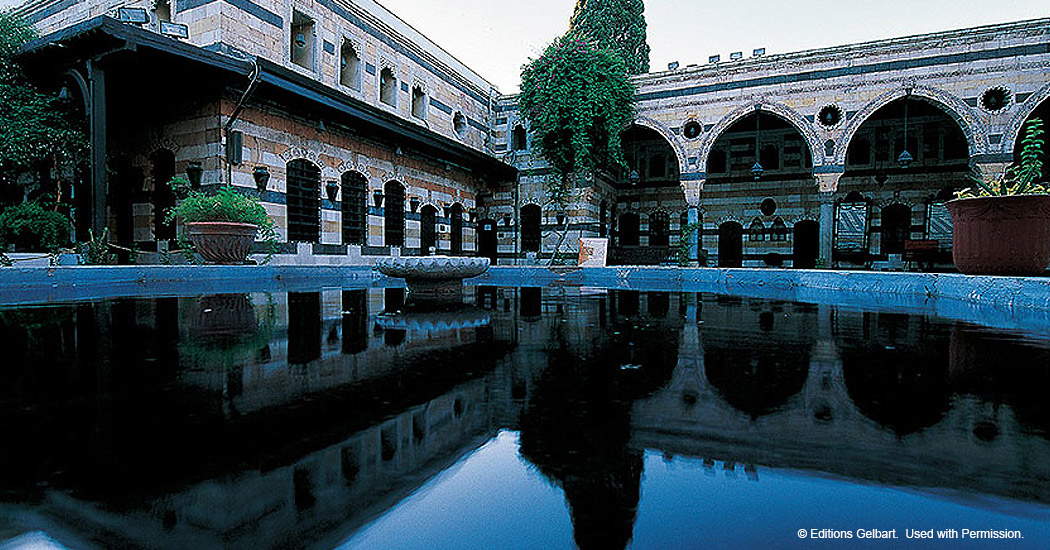
souk's entrance. The Khan El Franj is
one of the many khans or caravansaries built by Fakhreddine II for
merchants and goods. This is a typical khan with a large rectangular
courtyard and a central fountain surrounded by covered galleries. South of the souk on the way to the Castle of St. Louis, is the Great Mosque, formerly the Church of St. John of the Hospitalers. The four walls of this rectangular building (recently restored to their natural beauty) date to the 13th century. Originally a
fortress-like Crusader compound with its own chapel, it is still an
imposing struct 6 - Qalaat El Muizz or The Castle of St. Louis The Castle of St. Louis was erected on the emplacement of a Fatimid fortress during the Crusade led by French King Louis IX, popularly known as St. Louis. Built in the mid-13th century, the present state of the castle makes it easy to observe various stages of the restoration carried out in the Mamluke era, particularly work done in the 17th century by Emir Fakhreddine II. At the foot of the hill are a dozen or so Roman columns scattered on the ground. 7 - Murex Hill To the south of the citadel is a mound of debris called Murex Hill. This artificial hill (100 meters long and 50 meters high) was formed by the accumulation of refuse from the purple dye factories of Phoenician times. Mosaic tiling found at the top of the mound suggests that Roman buildings were erected there. The hill today is covered by houses and buildings as well as a cemetery. Broken murex shells can
still be seen on the lower part of the hill, but because of
extensive constru The three main necropoli of Sidon lie beyond the ancient city limits and were in use until the late Roman and early Christian eras. These are the necropolis of Magharat Abloun, the royal necropolis of Ayaa below the present village of Helalie, and the necropolis of Ain el Helwe to the southeast. Located in what are now residential areas, no excavations are in progress at any of these sites. South of the city an
ancient cemetery known as Dekerman was used until this century. It
is also an archaeological site, with an extensive collection of
objects, mostly sarcophagi and tombs in situ, as well as fragments,
inscriptions and sculptures. The Temple of Eshmoun At the right of the bridge on the Awali River just before reaching Sidon, is a spot known as "Bustan el Sheikh," site of the Temple of Eshmoun. This important monument goes back to the Persian period (6th century B.C.) when Sidon was at its zenith. As the god of healing, Eshmoun was identified with Asklepios, the Greek god of medical arts. Each Phoenician city state had its own gods, and Eshmoun was one of the favorite of Sidon during its golden age, the 6th and the 5th centuries B.C. Additions were made to the temple in subsequent eras and it remained a sacred shrine and place of pilgrimage well into the first centuries A.D. |
|
source: www.middleeast.com |